Russian
Engineering Decoding: The Art of Building "Absolute Stability" in Every Lift – The Underlying Logic of the Antmac Scissor Throw Platform
When constructing the cleanroom ceiling in a modern semiconductor wafer fab, the stability requirements for aerial work platforms reach the millimeter level: any tiny tremor can disrupt the delicate environment. Here, scissor lift platforms replace the concept of "traditional stability" with "engineering-grade stability."
In the global aerial work platform market, scissor lifts are considered synonymous with " basic stability " due to their structural advantages. True engineering-grade stability is a sophisticated science encompassing everything from material molecular structure to macroscopic system control.
This is not only the cornerstone of safety, but also a prerequisite for achieving high-efficiency and high-precision operations. When the platform carries two workers and hundreds of kilograms of tools at a height of 18 meters, its stability directly determines the success or failure of the project and its economic profitability.
01 Structural Redundancy: A Safety Design Philosophy Beyond Standards
In the field of engineering, "redundancy" is not waste, but rather a respect for unpredictable risks. The stability of scissor lift platforms stems primarily from the "over-specification" philosophy of their underlying structural design.
Antmac's scissor arms are made of high-strength manganese steel , which has a yield strength nearly twice that of ordinary structural steel. Each pair of scissor arms is not a simple "X-shaped" hinge, but rather has undergone tens of millions of dynamic load simulations through finite element analysis (FEA) , with reinforcement and local thickening treatment at the weakest points.
The direct benefit of this design is an increase in torsional stiffness of over 40%. This means that when the platform is subjected to eccentric loading (such as transporting heavy components on one side), the overall deformation of the platform is kept within a very low range, effectively preventing the center of gravity from shifting and swaying from structural deformation.
The essence of structural redundancy is to pre-build an "invisible skeletal system" to resist complex stresses at a microscopic scale that is imperceptible to users.
02 The Pivot Revolution: From "Passive Support" to "Active Adaptation" in Ground Interaction
The contact point between the platform and the ground is the starting point of the entire force transmission chain. Traditional outriggers only "support" the platform, while engineering-grade stability requires "integration and adaptation".
Antmac's bistable adaptive outrigger system is a game-changer. Each outrigger is equipped with a pressure sensor and a miniature hydraulic leveling cylinder at its end. Instead of extending all four legs simultaneously and assuming a perfectly flat ground when the equipment is deployed, the system first scans the ground pressure distribution using sensors.
When the system detects insufficient ground bearing capacity or a slope at a certain point, it will make millisecond-level fine adjustments , dynamically distributing the load on each outrigger to ensure that the four outriggers form an "absolutely flat" support foundation, keeping the chassis tilt within 0.5 degrees at all times. This is equivalent to establishing an active seismic-resistant base for the high-rise building, isolating the uncertainty of the ground from the lifting system.
Transforming every contact with the ground into a precise dynamic calibration is the core leap from "passive instability" to "active stability".
03 Drive Synchronization: Making "Lifting" a Harmonious Symphony
The stability of a scissor lift platform hinges on the synchronicity of its drive system, particularly its classic lifting motion. Asynchronous lifting is the primary cause of platform swaying, jamming, and even structural damage.
We abandoned the traditional multi-valve independent control and adopted a closed-loop proportional synchronous hydraulic system . This system is controlled by a central intelligent controller that monitors and compares displacement sensor data from multiple lifting cylinders in real time.
Once a millisecond-level difference in movement is detected, the controller immediately adjusts the flow and pressure of the corresponding oil circuit to achieve synchronous lifting with nanometer-level precision . This ensures that the left and right scissor arms move perfectly symmetrically, like a mirror, throughout the entire upward or downward movement, eliminating lateral shearing forces caused by asynchrony at the source.
Stability no longer depends solely on the robustness of the structure, but also on the precise coordination of every moment during the driving process.
04 The Heart of the Load: Intelligent Sensing and Dynamic Balance
The loads on the platform are not static. Personnel movement and tool handling will cause dynamic changes in the center of gravity. Engineering-grade stability requires the system to be able to "sense" and "respond" to these changes.
In some high-end models, we have integrated a three-dimensional dynamic load monitoring system . The sensor array located beneath the platform floor can not only measure the total weight, but also sense real-time changes in load distribution.
When the system determines that the load's center of gravity is continuously shifting to one side and approaching a safety threshold, it will first issue a visual graphic warning to the operator, prompting them to make adjustments. Furthermore, the system can work in conjunction with the drive system to slightly adjust the platform's attitude in extreme situations to compensate for the center of gravity shift, buying the operator valuable time to correct their actions.
This allows the platform to evolve from a passive carrier into an intelligent partner with "proprioception" and the ability to make preventative responses.
05 From the Lab to the Gobi Desert: The Ultimate Verification of Stability Across All Scenarios
True engineering-grade stability must withstand the most demanding environments. It is not just a laboratory report, but a performance declaration under diverse operating conditions worldwide.
In a desert solar power plant project in Saudi Arabia, Antmac's off-road scissor lift platform faced challenges such as a nearly 30- degree Celsius temperature difference between day and night, soft sand, and constant wind and sand erosion. The project team initially had serious concerns about the equipment's stability on the sandy terrain.
Our solution involved combining ultra-wide engineering tires to reduce ground pressure and activating a " soft ground mode " for the outrigger system. In this mode, the outriggers extend slowly with lower pressure and automatically lock once a solid load-bearing layer is found. Throughout the project cycle, the equipment achieved zero risk of overturning, and its stable performance even served as a benchmark platform for other processes on site.
Stability data is generated in the lab, but its value and trust are earned on the toughest construction sites in the corners of the world.
True stability means making the operator forget the existence of "stability" itself, thus focusing all their attention on the work at height. When an artist uses a scissor lift to restore a mural in a museum's central hall, the stability he needs is such that the tip of his brush does not deviate from the predetermined 0.1 millimeters due to the slightest tremor of the platform.
Antmac's pursuit of engineering-grade stability is precisely to embody this focus. It's not just about piling up steel and hydraulic transmission; it's a philosophy of certainty that completely excludes uncertainty from the system.
In a ceiling fresco restoration project at a century-old theater in Europe, the project supervisor required that the vibration amplitude of the aerial work platform at its maximum height be less than the human perception threshold. Ultimately, Antmac's silent electric scissor lift won the bid in comparative testing, achieving vibration control data three times better than traditional equipment. The project manager commented, "Its quietness and stability made our restoration experts feel as if they were standing on the dome of a cathedral, not as a machine."
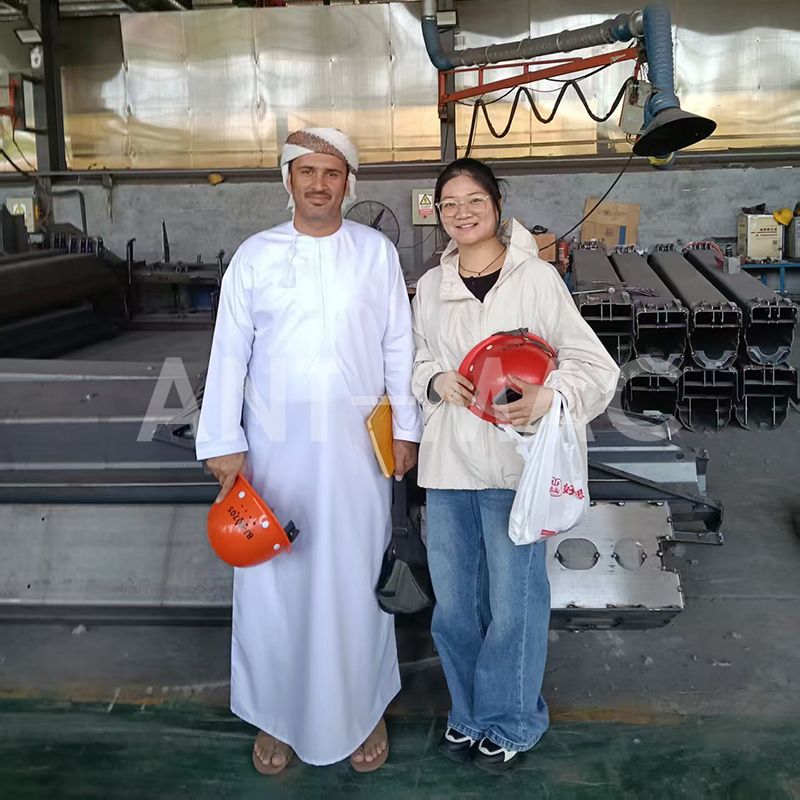 Saudi Customer Inspects 25Mete
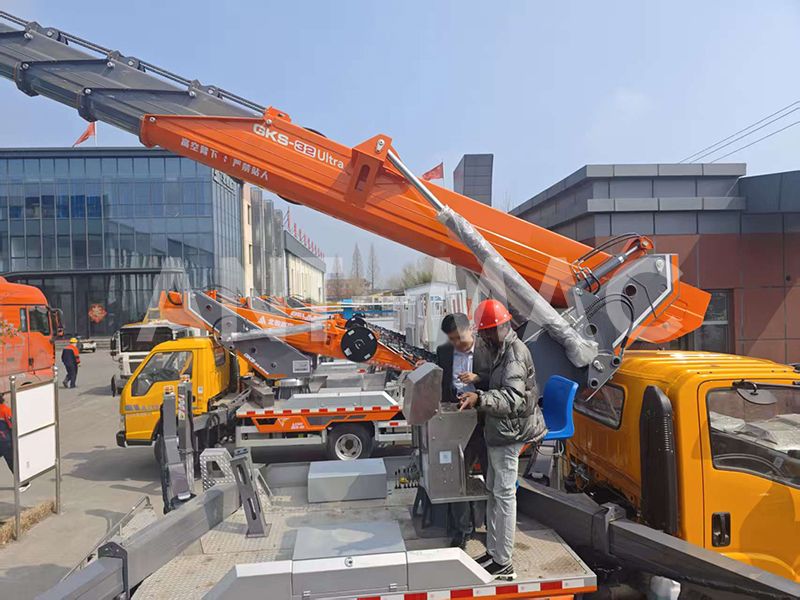 Armenian Customers Conducted A
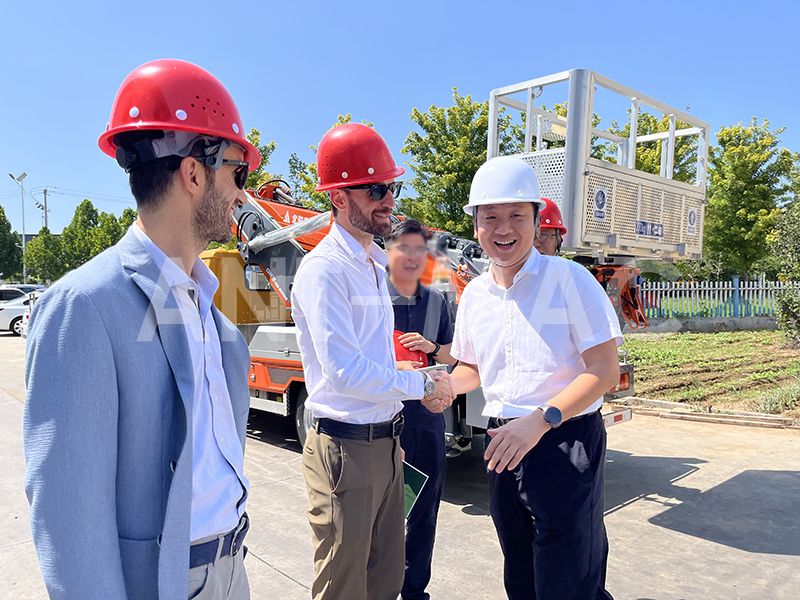 Malaysian Client Conducts On-S
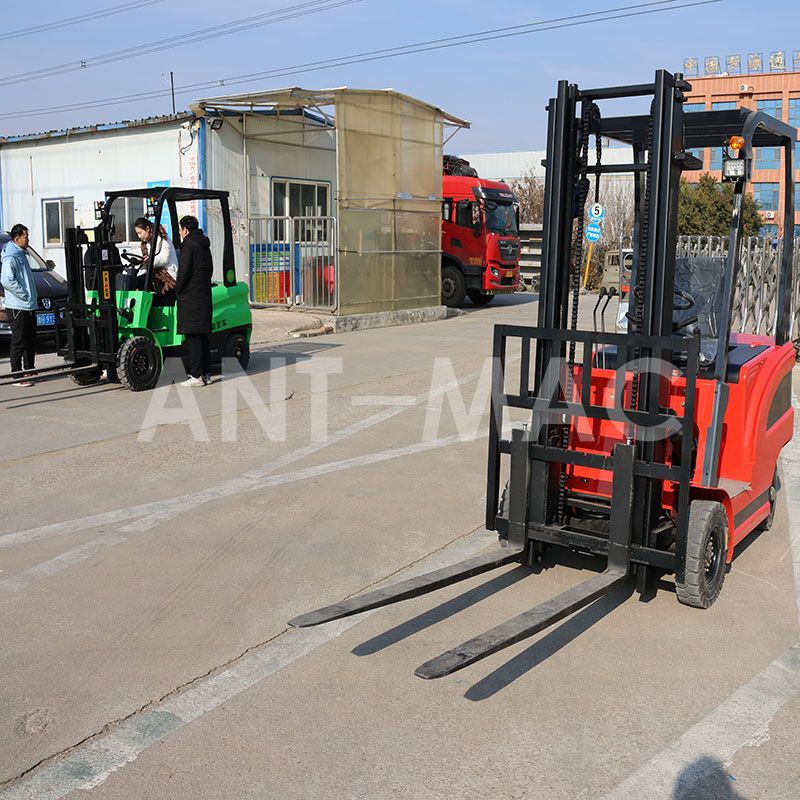 Dissecting the "Internal