Russian
A Cost-Effectiveness Revolution: Why Chinese Aerial Work Platforms Are Redefining the Value Standard in the Global Market
In the fiercely competitive international aerial work platform market, "Made in China" has quietly evolved from a synonym for "low price" to a top performer in terms of "performance-cost ratio" representing higher overall value. Especially in the field of vehicle-mounted platforms that combine mobility and operational efficiency, a "cost-performance revolution" driven by technology, supply chain, and in-depth services is underway.
Over the past decade, China's aerial work platforms, especially vehicle-mounted models, have seen a continuous increase in market share in the Middle East, Southeast Asia, Africa, and even Russia. This phenomenon is not the result of a price war, but rather stems from a group of leading Chinese manufacturers, represented by Antmac , who have systematically redefined the meaning of "cost-effectiveness" from three dimensions, making it the "optimal solution" to meet the needs of mainstream customers in emerging global markets.
First Dimension: The "Hard Currency" of Performance – From "Usable" to "Effective and Reliable"
Early cost-effectiveness advantages often came at the cost of performance compromises. Today, leading Chinese manufacturers, through technological integration and innovation, have raised key performance indicators to world-class levels, making them unquestionable "hard currency."
1. Core Technology Autonomy and Mature Supply Chain : China boasts the world's most complete basic industrial system and construction machinery supply chain. Taking load and control systems as an example, Chinese companies have widely adopted internationally mainstream standard hydraulic, electrical, and intelligent control system solutions to ensure that the stability, precision, and safety of core operations meet global standards. This eliminates customers' concerns about basic performance.
2. Targeted Adaptive Innovation : Chinese manufacturers excel at rapidly adapting products to specific markets (such as the high temperatures and humidity of Southeast Asia, the extreme cold of Russia, and the sandstorms of the Middle East). For example, enhanced cooling systems for high-temperature regions or reinforced off-road chassis for complex road conditions—these "non-standard" but crucial performance improvements can often be achieved with faster R&D speeds and lower marginal costs, precisely addressing customer pain points.
3. Data-driven reliability verification : Taking Antmac as an example, its invested and constructed intelligent manufacturing base and full-process quality inspection system ensure the consistency of product manufacturing. Through the accumulation of numerous domestic and international project cases, it has formed a reliability database covering various operating conditions, enabling it to provide customers with verified and predictable equipment performance.
Conclusion : When core performance parameters (such as working height, platform load capacity, and stability) are on par with international brands, and the product is more targeted and adaptable, the numerator of the "performance" cost-effectiveness formula becomes solid and attractive.
The second dimension: the "whole lifecycle" approach to costs and value—the visible and the invisible.
True value for money goes far beyond the "purchase price." Leading Chinese brands are committed to optimizing the "total lifecycle cost" for their customers, from purchase and use to maintenance.
1. The initial purchase cost advantage remains significant : relying on local large-scale manufacturing and supply chain efficiency, the direct purchase cost of products of the same specifications usually has an advantage of 20%-30% or even higher, which provides a lower capital threshold for project start-up or fleet expansion.
2. Transparency and controllability of usage and maintenance costs : Chinese equipment has high parts interchangeability, and because the supply chain is located domestically, spare parts for subsequent repairs and maintenance are available faster and at lower costs. More and more companies, such as Antmac , are establishing spare parts warehouses and service points in key overseas markets, significantly reducing downtime and directly lowering costly downtime.
3. The economic benefits of energy efficiency are becoming increasingly apparent : With the development of electrification and hybrid power technologies, Chinese companies have responded quickly to the field of new energy aerial work platforms. The energy consumption costs of these products in long-term use are far lower than those of traditional diesel equipment, providing customers who value long-term operating costs with a more forward-looking value option.
Conclusion : The value offered by Chinese equipment is a "total cost package" that includes lower capital requirements, less operational disruption, and better long-term energy efficiency , rather than just an attractive invoice price.
The third dimension: "Deep adaptation" to customer needs - not just selling equipment, but providing solutions.
The flexibility of Chinese manufacturers gives them a unique advantage in meeting diverse and even fragmented customer needs, which constitutes the crucial "service value" in cost-effectiveness.
1. Highly flexible configuration and customization capabilities : Unlike the standardized product orientation of international brands, Chinese manufacturers are more willing to provide customers with "menu-style" configuration options, and even moderate customization. Whether it is a special work platform size, a specific attachment interface, or special markings to comply with local regulations, a rapid response can be obtained, making the equipment truly "usable for us".
2. More Agile Financial and Service Solutions : To match the specific circumstances of customers in emerging markets, Chinese manufacturers can often partner with financial institutions to offer more flexible and diverse financing leases and installment payment options, reducing customers' cash flow pressure. This "buying solutions" rather than "buying assets" model is itself a manifestation of high cost-effectiveness.
3. From "Delivering Products" to "Delivering Productivity" : Leading Chinese companies are shifting their role from manufacturers to partners. They provide training for customers' operators, share best practices for different application scenarios, and even participate in early-stage construction plan discussions to ensure the maximum value of equipment.
Conclusion : This deep integration means that for every penny a customer spends, they not only get a machine, but also a set of "soft support" that enables it to generate benefits faster and better. The meaning of cost-effectiveness is thus extended to the entire cooperation experience.
Case Study: Antmac 's In-Vehicle Platform – A Practitioner of the Cost-Effectiveness Theory
Taking Antmac 's vehicle-mounted aerial work platform as an example, we can clearly see the integration of the above three dimensions:
1. Performance Foundation : Its products utilize high-strength steel and mature powertrain assemblies, offering comprehensive working height coverage and internationally certified safety systems. The "Extreme Cold Pack" launched specifically for the Russian market is a prime example of performance-oriented innovation.
2. Cost Control : Relying on its modern production base in Shandong (covering 250 acres with a total investment of 300 million RMB), large-scale production and automated processes effectively control manufacturing costs. Its global spare parts network aims to reduce customers' long-term holding costs.
3. Value Extension : The company can provide a comprehensive range of services for large-scale overseas projects, from equipment selection and financial solutions to localized technical training. Its product line is complete, ranging from standard equipment to high-end equipment, and can be flexibly configured to perfectly meet the needs of different budgets and scenarios, from municipal maintenance to large-scale industrial installations.
Future competition will not only be about price, but also about the efficiency of value innovation. The cost-performance advantage of Chinese aerial work platform manufacturers is built on their rapid technology learning and application capabilities, their flexible manufacturing system that deeply understands and meets differentiated needs, and their continuously improving global service ecosystem .
For global customers, choosing a Chinese-made vehicle-mounted aerial work platform is no longer a second-best "economical option," but a wise "value investment"—gaining a reliable, highly adaptable, and continuously supported efficiency tool with a reasonable total investment. This is the fundamental reason why Chinese aerial work platforms are gaining increasing popularity in the "cost-effectiveness" segment .
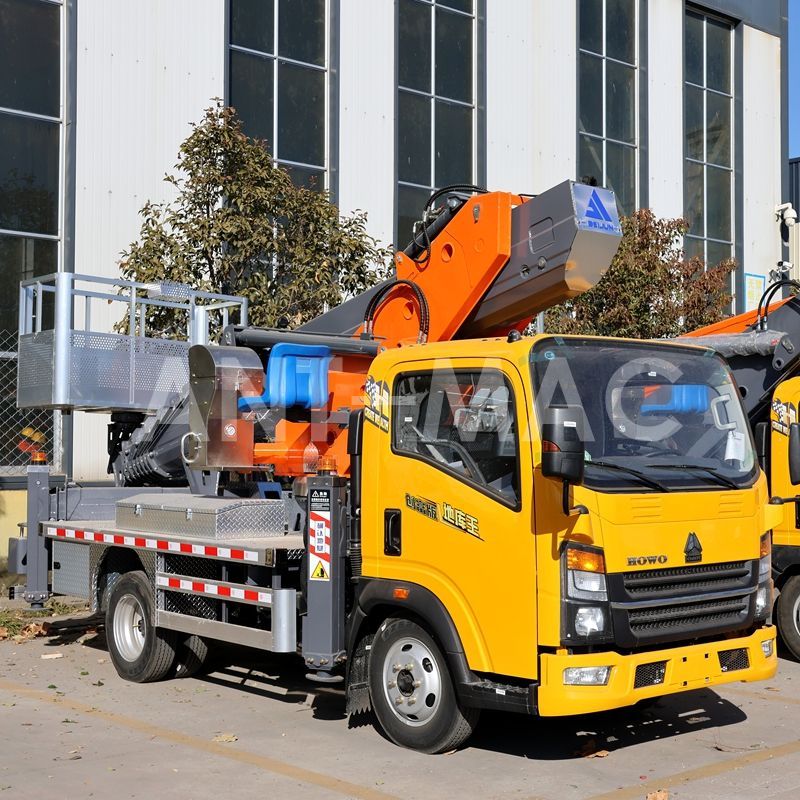 Ant-Mac Aerial Work Platforms
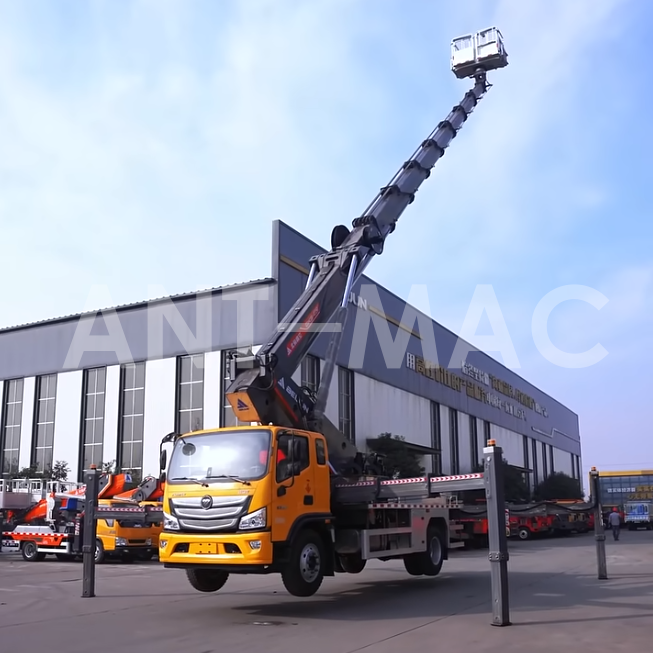 Global Aerial Work Platform Ma
 Malaysian Customer Purchases A
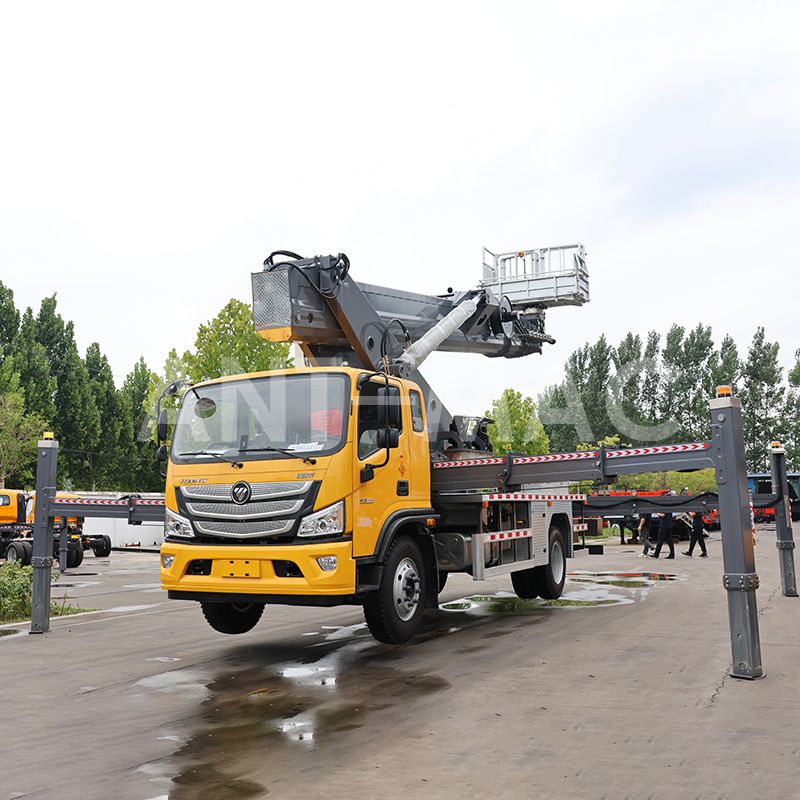 Comprehensive Upgrade of Safet